

 by
by The world of quantum technology is evolving faster than ever before. Once considered purely experimental, quantum computing innovations are now entering real-world applications — from cybersecurity to medicine and climate modelling. As tech giants and research institutes push new computing breakthroughs, we’re witnessing a technological revolution that could redefine the limits of what machines can achieve.
See Forbes’ full list of current quantum breakthroughs
What Is Quantum Computing and Why It Matters
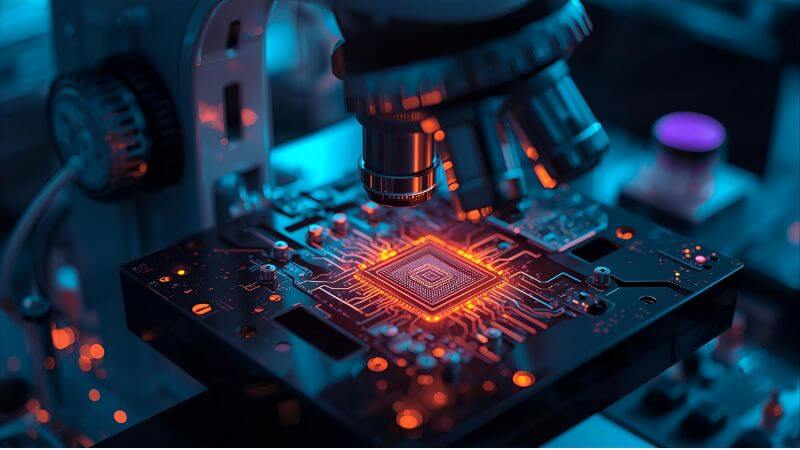
At its core, quantum computing relies on the principles of quantum mechanics — superposition, entanglement, and tunneling. Instead of using binary bits (0 or 1), quantum computers use “qubits” that can exist as both simultaneously. This allows them to process vast datasets and perform computations impossible for traditional computers. As IBM explains, this unique structure makes quantum systems exponentially more powerful for specific tasks.
Why does this matter? Because today’s biggest challenges — from drug discovery to global logistics — demand calculations beyond classical limits. That’s where quantum technology comes in. According to Investopedia, quantum computing could reshape industries by enabling faster, smarter decision-making and advanced simulation power.
Quantum’s Real-World Impact
Beyond theory, companies like Google, Microsoft, and IBM are competing to make practical quantum computers accessible through the cloud. MIT Technology Review notes that we’re transitioning from “quantum curiosity” to “quantum commercialization.”
1. Breakthroughs in Quantum Error Correction

For decades, one of quantum computing’s biggest challenges was maintaining qubit stability. Even minor temperature or magnetic fluctuations could cause data loss — known as “decoherence.” Today, that’s changing. Scientists at NIST and the Google Quantum AI Lab recently demonstrated powerful error-correction algorithms that preserve quantum states for longer periods.
In early 2025, Google unveiled a 72-qubit processor, “Bristlecone,” with record-low error rates. Researchers claim it could lead to fault-tolerant quantum systems capable of solving problems traditional computers can’t touch. According to Scientific American, this step brings us closer to practical, stable quantum computing.
Learn how error-free computing affects AI development (example.com)
2. Quantum Materials and Next-Gen Hardware
Quantum hardware is advancing through innovations in superconducting materials and trapped-ion systems. BBC Future recently highlighted breakthroughs in cryogenic chip design that could support larger qubit arrays with less noise.
Companies like Intel are investing heavily in silicon-based spin qubits — compatible with existing semiconductor fabrication. Meanwhile, Microsoft is pursuing “topological qubits” using exotic matter states. These are far more stable and scalable than traditional designs.
According to Nature, such material advances could enable quantum processors with thousands of qubits — a milestone many once thought decades away.
Why This Matters
Better materials equal faster, more reliable machines. These innovations pave the way for high-efficiency energy systems, secure communication, and AI-driven data science applications — all powered by quantum technology.
3. Cloud-Based Quantum Platforms
Access to quantum computing is no longer limited to researchers. Cloud-based platforms from Amazon Braket, IBM Quantum, and Azure Quantum now let developers experiment with quantum circuits from anywhere.
This democratization of quantum computing innovations helps startups, scientists, and even students run real quantum simulations without owning expensive hardware. According to Forbes Technology Council, hybrid computing — combining classical and quantum resources — will dominate enterprise adoption strategies over the next decade.
Explore how cloud quantum platforms integrate into business systems (example.com)
4. Quantum Algorithms Revolutionizing Industries

It’s not just hardware — software breakthroughs are equally transformative. Quantum algorithms allow companies to model molecules, optimize traffic, and improve AI training efficiency. Nature Journal reports that quantum algorithms could outperform classical ones in energy grid optimization and logistics planning.
In healthcare, researchers at Mayo Clinic are collaborating with IBM to use quantum computing for drug design and genomic analysis. Similarly, Goldman Sachs has announced early use of quantum algorithms to model complex financial systems faster than ever before.
As The Guardian reports, these breakthroughs will likely redefine AI and cybersecurity within the decade.
Example Applications
- Drug discovery and protein folding analysis
- Energy storage optimization and renewable management
- Quantum encryption and blockchain verification
- Financial modelling for risk management
5. Quantum Communication and Secure Networking

Another frontier of quantum technology lies in secure data transmission. Quantum communication uses entangled particles to create unhackable encryption keys. China’s Micius satellite and Europe’s Quantum Internet Alliance are pioneering large-scale quantum networks.
According to Scientific American, quantum key distribution (QKD) will be central to cybersecurity by 2030. It ensures that any interception attempt instantly alters the data — alerting both parties.
Quantum communication, combined with Harvard’s research in quantum memory and photonics, may soon power a fully functional “quantum internet.”
6. Hybrid Quantum–Classical Computing

The near future won’t replace classical computing — it’ll enhance it. Hybrid systems that integrate classical CPUs with quantum processors are already showing promise. MIT Technology Review highlights companies using hybrid architectures for climate simulations, AI, and materials development.
This synergy enables faster problem-solving across industries. As CNBC Tech reports, enterprises are preparing hybrid infrastructures that can leverage both quantum and traditional computing resources efficiently.
Why It’s the Future
Hybrid systems will bridge the gap between today’s limited quantum computers and tomorrow’s fully scalable quantum machines. They represent a practical path forward in the ongoing computing breakthroughs race.
Preparing for the Quantum Revolution

Experts agree that organizations must start preparing now. According to McKinsey, quantum technology could disrupt supply chains, finance, and cybersecurity by the early 2030s. Businesses that adopt early will enjoy major strategic advantages.
If you’re a professional or entrepreneur, the time to upskill is now. Consider learning quantum programming languages like Q# or Qiskit and exploring platforms that simulate quantum circuits.
See our guide on integrating quantum tech into your business (example.com)
Final Thoughts: A New Age of Computing Breakthroughs
The field of quantum computing innovations is moving faster than anyone imagined. With stable qubits, error-corrected systems, cloud access, and hybrid solutions, the foundation for mainstream quantum adoption is already here. These computing breakthroughs won’t just change technology — they’ll reshape science, economics, and everyday life.
The next decade won’t belong to faster classical processors but to smarter quantum ones. The race to harness quantum technology is on, and its winners will define the future of computing itself.